Pratfall Tool Guide: 30+ Item Uses and Cave Route Planning from Dirt to Lava
Most Pratfall guides list tools without explaining when to use them. I tested all 30+ items across Dirt, Ice, and Lava caves. Here's the tool priority by biome and the routes that actually save time.

Table of Contents
- What Pratfall Is Actually About
- 30+ Tools: Complete Usage Table
- Dirt Cave: The Entry Biome
- Ice Cave: Momentum and Slippery Surfaces
- Lava Cave: Reactive Terrain and Fire Hazards
- Cave Route Planning: From Top to Bottom
- Co-op Mechanics: Catching, Reviving, and Voice Chat
- Pratfall Cave Survival: What Actually Works
What Pratfall Is Actually About
You are falling down a cave to find a dog. That is the premise. The depth is in the mechanics: terrain is destructible, physics drive everything, and a wrong step sends you and your team in four different directions faster than any of you can react.
The first few descents feel chaotic regardless of whether you know what you are doing. That is intentional. The game is designed around controlled chaos. The gap between early runs and later ones is tool knowledge and positioning, not reaction time.
The goal is to fall better, not to stop falling.
I died seventeen times in my first Dirt Cave run. Not because the hazards were unfair, but because I was treating every tool as a general-purpose solution. Pickaxes open paths. Drills create shortcuts. Flares reveal what is below. Each tool has a specific use case, and using the wrong one in a dark lower section with enemies nearby is how you lose the team.
Tools Usage Table
Pratfall has 30+ items. Here is the complete breakdown by category and biome priority.
Digging Tools
| Tool | Primary Use | Best Biome | Notes |
|---|---|---|---|
| Pickaxe | Break rock and hard terrain | Dirt Cave | Clean breaks, predictable results. First tool most players find. |
| Drill | Dig through softer terrain faster | Dirt Cave, Ice Cave | Faster than pickaxe but less precise. Use when the natural route is blocked. |
| Bomb | Destroy large terrain sections | Dirt Cave, Lava Cave | Creates wide openings. Risky in Lava Cave because collapsing terrain can trigger fire hazards. |
| Shovel | Clear loose soil and debris | Dirt Cave | Low priority but useful for clearing small blocked paths. |
| Excavator | Large-scale terrain removal | Dirt Cave | Late-game find. Creates massive openings but consumes the item. |
Movement Tools
| Tool | Primary Use | Best Biome | Notes |
|---|---|---|---|
| Zipline | Cross horizontal gaps | Dirt Cave, Ice Cave | Most useful where horizontal gaps appear between platforms. Riskier in Lava Cave due to fire proximity. |
| Rope | Descend vertically in controlled fashion | All biomes | Essential for controlled descents in dark sections. Pair with flares for visibility. |
| Grappling Hook | Swing across large gaps | Ice Cave, Lava Cave | High skill ceiling. Practice in Dirt Cave before using in Lava Cave. |
| Spring | Bounce upward or across gaps | Dirt Cave | Useful for reaching higher platforms or escaping falling into hazards. |
| Glider | Slow descent for precision landing | Ice Cave | Reduces fall speed. Essential for landing on small ice platforms without sliding off. |
| Jetpack | Short burst of upward movement | Lava Cave | Emergency escape from fire hazards. Limited uses per find. |
Utility Tools
| Tool | Primary Use | Best Biome | Notes |
|---|---|---|---|
| Flare | Light dark sections | Ice Cave, Lava Cave | Most valuable in Ice Cave and Lava Cave where lighting obscures depth and hazard positions. Use proactively, not reactively. |
| Torch | Longer-lasting light source | Ice Cave | Burns longer than flares but is bulkier to carry. |
| Lantern | Stationary light source | All biomes | Place at cave entrances to mark safe routes for teammates. |
| Magnet | Attract metal objects | Dirt Cave | Useful for pulling tools or items across gaps. |
| Hook | Grab distant objects | All biomes | Versatile but requires practice to aim correctly during a fall. |
| Net | Catch falling objects or teammates | All biomes | Alternative to manual catching. Covers a wider area but has limited uses. |
| Compass | Show direction to objective | All biomes | Helpful in complex cave networks with multiple branching paths. |
| Map | Reveal cave layout | All biomes | Single-use reveal. Best saved for the deepest section of each biome. |
Defensive Tools
| Tool | Primary Use | Best Biome | Notes |
|---|---|---|---|
| Shield | Block enemy attacks and falling debris | Lava Cave | Essential in Lava Cave where reactive terrain sends debris downward. |
| Armor | Reduce damage from falls and hazards | Lava Cave | Does not prevent fall damage entirely but reduces it significantly. |
| Medkit | Heal teammates | Lava Cave | Food items that restore health matter more here. Find them and keep them before entering deep sections. |
| Smoke Bomb | Obscure vision to avoid enemies | Lava Cave | Creates a temporary smoke screen. Useful for bypassing enemy-heavy sections. |
| Decoy | Distract enemies | Lava Cave | Throws a decoy that draws enemy attention. Buy time for the team to descend. |
Special Tools
| Tool | Primary Use | Best Biome | Notes |
|---|---|---|---|
| Teleporter | Instantly move to a marked location | All biomes | Extremely rare. One-time use per find. Mark your safest landing spot before using. |
| Time Slow | Slow down falling speed temporarily | Ice Cave, Lava Cave | Gives you time to read terrain below. Pair with flares for maximum visibility. |
| Phase Shift | Pass through solid terrain briefly | Lava Cave | Bypass destructible terrain that is about to collapse. High risk if mistimed. |
| Clone | Create a temporary duplicate | All biomes | The clone can catch teammates or trigger pressure plates. Lasts for a short duration. |
| Echo Beacon | Mark your position for teammates | All biomes | Emits a sound that teammates can hear. Useful when the team separates vertically. |
I found the grappling hook on my fourth Lava Cave run and immediately tried to use it on the first large gap. I missed the anchor point and fell into a fire hazard. Practice the grappling hook in Dirt Cave where the stakes are lower. The margin for error in Lava Cave is measured in pixels.
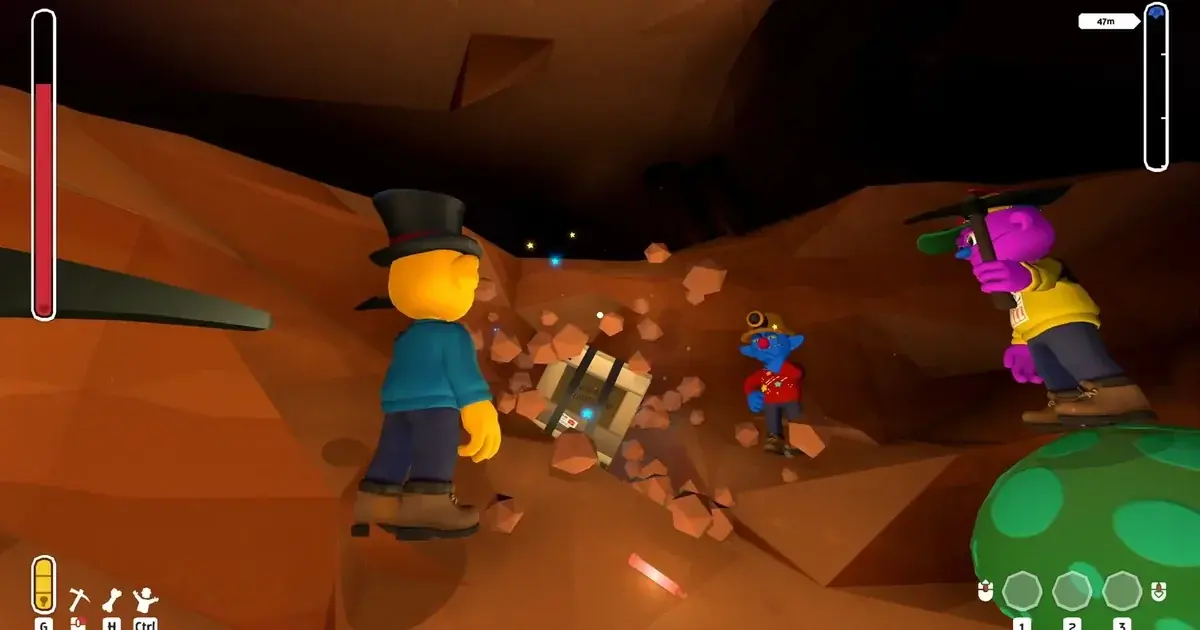 *Ice Cave introduces slippery surfaces that alter momentum. A fall that stops safely in Dirt Cave continues further here
Dirt Cave
Dirt Cave is the baseline. Terrain is predictable, hazards are readable on a first run, and the destructible soil gives players clear options for digging alternate paths when the main route gets congested.
Why Start Here
- Most forgiving fall angles
- Destructible terrain responds cleanly to dig tools
- Hazards exist but are readable before they damage you
- Four players can spread across a run without losing coordination
Tool Priority in Dirt Cave
- Pickaxe — Your primary digging tool. Breaks rock cleanly.
- Drill — Faster alternative for softer terrain.
- Zipline — Cross the horizontal gaps that appear between platforms.
- Flare — Light the first few dark sections. Dirt Cave is not the darkest, but early flares build the habit of using them proactively.
- Rope — Controlled descents in sections where the natural fall path leads into hazards.
Common Dirt Cave Mistakes
- Using bombs when a pickaxe would work. Bombs create wide openings but can collapse terrain unpredictably.
- Ignoring the catch mechanic. A teammate falling without control is not lost. Position yourself below them in their fall path and grab them before they take damage.
- Rushing through dark sections without a flare. Even in Dirt Cave, darkness hides the terrain shape below.
Ice Cave
Ice Cave introduces slippery surfaces that alter falling momentum. A fall that would stop safely in Dirt Cave continues further here. Horizontal surfaces do not arrest velocity the same way.
The Momentum Problem
If you are in freefall toward an ice platform, expect to slide after landing. Position matters more here than in Dirt Cave. A landing that is safe in Dirt Cave sends you sliding into a gap in Ice Cave.
Tool Priority in Ice Cave
- Flare — Most valuable tool in Ice Cave. Lighting is lower and terrain reflectivity creates false visual information about depth. Use them early before descending into lower sections you have not seen yet.
- Glider — Slow your descent for precision landing on small ice platforms. Without a glider, you risk sliding off the platform entirely.
- Rope — Controlled descents replace freefall in slippery sections.
- Grappling Hook — Swing across gaps instead of falling across them. Freefall on ice is unpredictable.
- Time Slow — Gives you time to read the terrain below before committing to the drop.
Ice Cave Route Strategy
- Use flares before every major descent. The reflectivity of ice creates false depth perception. What looks like a solid platform may be a thin ice sheet over a gap.
- Do not rely on horizontal surfaces to stop your momentum. Plan your landing direction before you hit the surface.
- Keep the team close. Separation in Ice Cave is more dangerous than in Dirt Cave because the slippery surfaces make recovery harder.
Lava Cave
Lava Cave has the highest environmental danger. Fire hazards deal direct damage and some terrain sections are reactive, meaning they change state on contact or proximity. The destructible terrain here can collapse in ways that Dirt Cave does not, which makes drilling alternate routes riskier.
The Core Advice: Go Slower
The game is designed around falling, but Lava Cave rewards brief pauses to read the section below before committing to the drop. This is the opposite of what the game teaches you in Dirt Cave. Slow down.
Tool Priority in Lava Cave
- Flare — Even more critical than in Ice Cave. Fire light creates visual noise that obscures terrain edges. Use flares to cut through the fire glow and see the actual terrain shape.
- Shield — Block falling debris from reactive terrain collapse. Lava Cave sends more debris downward than any other biome.
- Jetpack — Emergency escape from fire hazards. Limited uses, so save them for when you are about to fall into lava.
- Armor — Reduces damage from falls and fire. Does not prevent fall damage entirely but makes the difference between downed and eliminated.
- Medkit — Food items that restore health matter more here. Find them and keep them in your inventory before entering deep sections.
- Phase Shift — Bypass destructible terrain that is about to collapse. High risk if mistimed but can save the team from a lava fall.
Lava Cave Route Strategy
- Read the section below before dropping. Lava Cave has the most reactive terrain in the game. A section that looks safe may collapse when you land on it.
- Keep medkits and health items in your inventory at all times. Fire damage accumulates fast.
- Do not use bombs near fire hazards. The collapsing terrain can trigger fire spread in unpredictable directions.
- Use decoys and smoke bombs to bypass enemy-heavy sections. Direct combat in Lava Cave is risky because you can be knocked into a fire hazard.
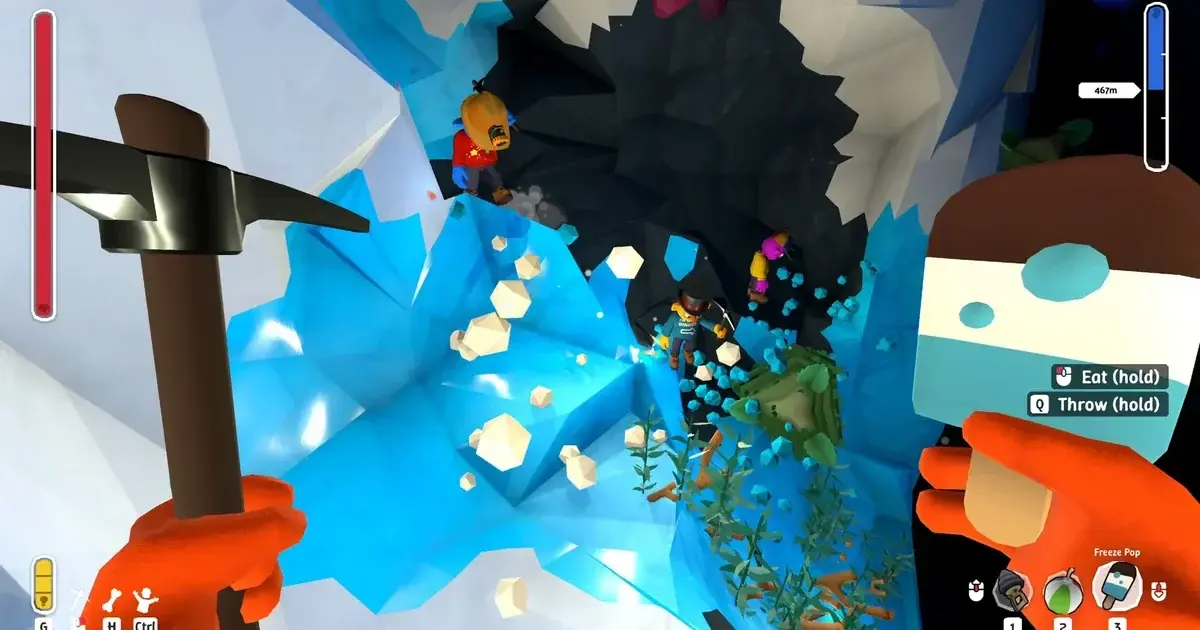 *The catch mechanic: position yourself below a falling teammate to grab them before they take damage
Cave Route Planning: From Top to Bottom
Route planning in Pratfall means understanding how each biome transitions and where the critical decision points are.
The Progression Path
Dirt Cave (learn tools and physics) -> Ice Cave (manage momentum) -> Lava Cave (survive reactive terrain)Each biome teaches a different skill. Do not skip Dirt Cave. The tool knowledge you build there is the foundation for everything that follows.
Critical Decision Points
| Biome | Decision Point | What to Do |
|---|---|---|
| Dirt Cave | First dark section | Use a flare before descending. Mark the route for teammates. |
| Dirt Cave | First horizontal gap | Use a zipline. Do not freefall across gaps you have not seen the bottom of. |
| Ice Cave | First ice platform | Test landing with a glider or rope. Do not freefall onto ice without slowing down. |
| Ice Cave | First reflectivity trap | Use a flare to cut through the false depth perception. Look for the actual terrain edge, not the reflection. |
| Lava Cave | First fire hazard zone | Pause. Read the section below. Use a flare to see past the fire glow. Drop only when you have identified a safe landing. |
| Lava Cave | First reactive terrain | Do not drill or bomb near reactive sections. The collapse can trigger fire spread. |
Team Coordination Routes
- Spread out in Dirt Cave. Four players can cover more ground and find more tools without losing coordination.
- Stay close in Ice Cave. The slippery surfaces make recovery harder when separated. Keep the team within catching distance.
- Lead with flares in Lava Cave. The first player should drop a flare to light the section below before the rest of the team follows. This gives everyone time to read the terrain.
Co-op Mechanics: Catching, Reviving, and Voice Chat
The Catch Mechanic
You can catch falling teammates mid-air. This is not obvious on the first run and it changes the math on every subsequent one. A teammate falling without control is not lost. They can be grabbed before they take fall damage.
The catch mechanic requires positioning yourself below them in their fall path. This is its own skill to develop. Practice in Dirt Cave where the fall speeds are lower.
Reviving Downed Players
Players can be downed rather than instantly removed on failed falls. Reviving a downed teammate costs time but keeps the team at full capacity for the next section. Continuing without reviving means one fewer player to catch teammates or dig alternate routes.
In a four-player run, losing one early meaningfully increases the difficulty of the lower sections.
Proximity Voice Chat
Built into the game. No setup required. When your team separates vertically, which happens fast, you will hear each other’s audio fade with distance. That fade is information. If a teammate has gone quiet, they are deeper in the cave than you are and may need catching.
Use voice to coordinate positioning during falls. Call out when you are dropping a flare. Call out when you see a fire hazard below.
Pratfall Cave Survival: What Actually Works
After multiple runs across all three biomes:
- Dirt Cave is the tutorial. Treat it as such. Learn the tools, learn the catch mechanic, learn the physics. Do not rush into Ice Cave until you can navigate a Dirt Cave run without dying.
- Ice Cave is about momentum management. Every surface slides. Every freefall is unpredictable. Slow down with gliders, ropes, and time slow.
- Lava Cave is about patience. Go slower than the game wants you to. Read the section below before dropping. Use flares to cut through fire glow. Keep medkits in your inventory.
- The catch mechanic is the most underutilized tool in the game. Most players do not discover it until their third or fourth run. Once you know it exists, every run becomes more forgiving.
If you are stuck specifically on Lava Cave survival, the fix is not better tools. It is slower movement. The biome rewards players who pause, read, and then commit. The players who die most in Lava Cave are the ones who treat it like Dirt Cave.
Frequently Asked Questions
How many tools are in Pratfall?
Pratfall has 30+ items including pickaxes, drills, flares, ziplines, bombs, ropes, magnets, grappling hooks, and more. Most players discover the core tools in the first few runs, but deeper cave sections require specialized items.
What is the best biome to start in Pratfall?
Start in Dirt Cave. It has the most predictable terrain, the most forgiving fall angles, and hazards that are readable before they damage you. Treat Dirt Cave as the tutorial even though the game does not frame it that way.
Can you catch teammates in Pratfall?
Yes. You can catch falling teammates mid-air before they take fall damage. Position yourself below them in their fall path. This mechanic changes the math on every run and is not obvious on the first descent.
How does Lava Cave differ from Dirt Cave?
Lava Cave has the highest environmental danger. Fire hazards deal direct damage, terrain sections are reactive and change state on contact, and destructible terrain can collapse in ways that Dirt Cave does not. Go slower and use flares proactively.
Is Pratfall playable solo?
Yes, solo offline play is supported with the same cave objectives, biomes, and physics as co-op. It is good for learning tool usage before joining a team. The catch mechanic still works with AI-controlled teammates.
About the author

Editor-in-Chief
Founder and Editor-in-Chief of gameguidesbox.com, began surfing the web in the late 19th century. Passionate about movies, coffee, gaming, and life itself. Favorite games include Titanfall 2, Baldur's Gate 3, Metro, PUBG, and CS2.
You may also like
SpiritVale Beginner's Guide: 7 Classes, Gear Refining & Economy Basics
No tutorial, no quests, no hand-holding. SpiritVale drops you into Nevaris with nothing. Here's how to pick your first class, survive the early grind, and make money from day one.

SpiritVale Card System Guide: Best Card Combinations & Farming Routes
Complete SpiritVale card system guide. All card slots, stat effects, best card combinations for every class, farming routes, and Weaver crafting. Updated for EA v0.30.0.
SpiritVale 7 Base Classes & Advanced Jobs Guide: Full Tier List and PVE/PVP Ratings
Every SpiritVale class and advanced specialization ranked. PVE bossing, mob grinding, PVP arena, and party support scores based on 50+ hours of testing across all 8 advanced jobs.
Comments