Dwarf Eats Mountain vs Cookie Clicker and Melvor Idle Review
I put 200+ hours across the big incremental games. Here is where Dwarf Eats Mountain wins with its physics layer and where it falls short against the genre.
Table of Contents
- The Genre Context: Prestige-Based Incrementals in 2026
- Vs Cookie Clicker: Active vs Passive Decision Making
- Vs Melvor Idle: Breadth vs Depth
- Vs Antimatter Dimensions: The Physics Layer Difference
- Comparison Table: What Each Game Does Best
- Where Dwarf Eats Mountain Falls Short
- Who Should Play Dwarf Eats Mountain (And Who Shouldn’t)
- Final Verdict: 50+ Hours Well Spent
The Genre Context: Prestige-Based Incrementals in 2026
The incremental/idle genre has evolved significantly since Cookie Clicker defined the template in 2013. The core loop (do thing → number go up → reset for bonus → repeat faster) has been refined across dozens of games. Dwarf Eats Mountain enters a crowded field where standing out requires more than just “number go up good.”
Three games define the genre’s modern landscape: Cookie Clicker (the granddaddy), Melvor Idle (the RuneScape-inspired depth), and Antimatter Dimensions (the Prestige-system architect). Dwarf Eats Mountain takes lessons from all three and adds its own physics layer.
Vs Cookie Clicker: Active vs Passive Decision Making
Cookie Clicker is the baseline. Click cookie, buy upgrade, number goes up, reset for heavenly chips. The strategy is primarily about timing — when to ascend, which upgrades to buy in what order.
Where Cookie Clicker wins:
- True idle experience. You can close the game for a week and come back to meaningful progress
- Deep upgrade trees with hundreds of options
- Established community, wikis, calculators for optimal play
Where Dwarf Eats Mountain wins:
- Decisions matter more. Build order and dwarf class balance have real consequences that compound across a run
- Active play is rewarded. Watching your dwarves and adjusting in real-time beats a fixed cookie-buying rotation
- The physics layer adds visual engagement. Watching runners dodge rocks or Flamers roast a mountain segment is satisfying in a way spreadsheets aren’t
The tradeoff: Cookie Clicker respects your absence. Dwarf Eats Mountain rewards your presence. If you want an idle you can play while doing other things, Cookie Clicker wins. If you want an incremental that demands your attention, Dwarf Eats Mountain takes it.
Vs Melvor Idle: Breadth vs Depth
Melvor Idle is the deepest incremental on the market in terms of content breadth. 20+ skills, each with its own progression tree, gear, and unlock path. It’s a parallel-progression monster.
Where Melvor Idle wins:
- Unmatched content breadth. Hundreds of hours of progression across independent skill trees
- Complex optimization. Gear sets, synergies, and efficiency calculations for dedicated players
- Active combat system with boss mechanics
Where Dwarf Eats Mountain wins:
- Run-based Prestige system creates clearer goals and reset points. Each run has a beginning, middle, and end
- Resource competition forces real tradeoffs. In Melvor, you can level everything in parallel. In Dem, choosing between Flamer and Demolition matters
- The artifact system creates more build variety than Melvor’s gear system because artifact effects are more transformative
The tradeoff: Melvor Idle is the game you play for 500 hours across every skill. Dwarf Eats Mountain is the game where every Prestige run feels meaningfully different because of artifact RNG and build choices.
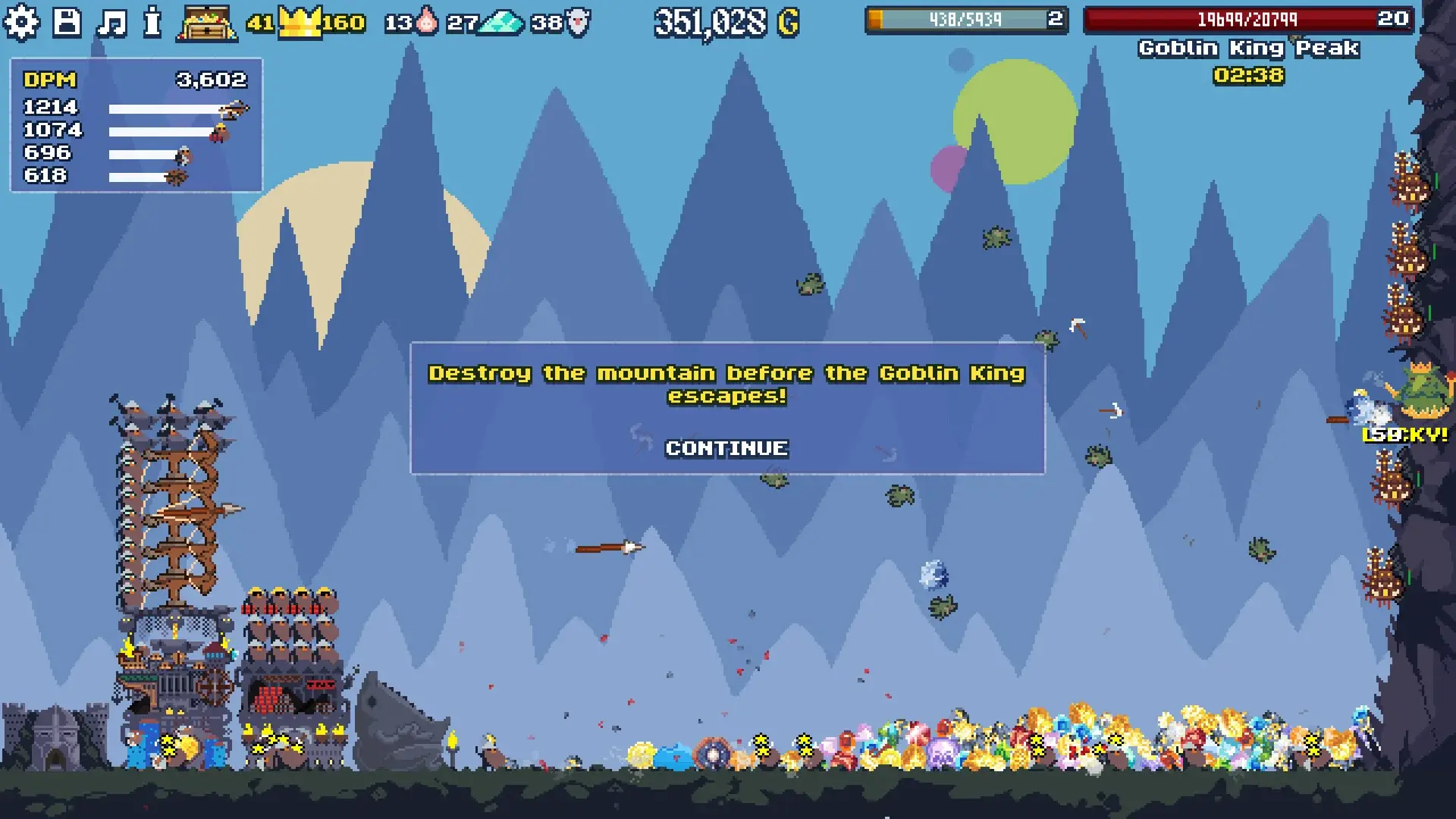 A full mid-to-late-game Dwarf Eats Mountain setup. Multiple buildings, dwarf classes, and systems visible simultaneously.
Vs Antimatter Dimensions: The Physics Layer Difference
Antimatter Dimensions essentially invented the modern Prestige system template that Dwarf Eats Mountain uses. Challenges, upgrades, resets, repeat. It’s a masterclass in pure number scaling.
Where Antimatter Dimensions wins:
- Cleaner, more intuitive Prestige progression. The game teaches you its systems one at a time
- Better pacing. Each new mechanic is introduced when the previous one starts to feel stale
- More mathematical depth for players who want to optimize evertying down to the tick
Where Dwarf Eats Mountain wins:
- The physics layer makes abstract numbers feel physical. Miners, runners, rocks, fire — it’s a simulation, not a spreadsheet
- Calamity system adds active pressure that AD’s time-based challenges don’t
- The artifact RNG system creates more variance between runs. In AD, every run at the same stage is identical. In Dem, artifact drops change your approach
The tradeoff: Antimatter Dimensions is the purer incremental experience. Dwarf Eats Mountain trades some mathematical elegance for physical engagement and variance.
Comparison Table: What Each Game Does Best
| Dimension | Cookie Clicker | Melvor Idle | Antimatter Dimensions | Dwarf Eats Mountain |
|---|---|---|---|---|
| Idle passive progress | ★★★★★ | ★★★★ | ★★★ | ★★ |
| Active decision making | ★★ | ★★★★ | ★★★ | ★★★★★ |
| Content breadth | ★★★★ | ★★★★★ | ★★★ | ★★★ |
| Run variance (replayability) | ★★ | ★★★ | ★★ | ★★★★★ |
| Visual engagement | ★★★ | ★★ | ★ | ★★★★ |
| Community/docs | ★★★★★ | ★★★★ | ★★★★ | ★★ |
| Endgame depth | ★★★★ | ★★★ | ★★★★ | ★★★★ |
| New player learning curve | ★★★★★ | ★★★ | ★★★ | ★★ |
Where Dwarf Eats Mountain Falls Short
I’m not going to pretend this game is perfect. After 40+ hours, these are the real problems:
1. Performance issues in late game. The game uses physics objects for ore, projectiles, and dwarves. Late game with 30+ dwarves, hundreds of ore pieces, and multiple particle effects, frame rates drop significantly. The developer recommends the desktop version over browser for this reason.
2. Community documentation is thin. The wiki exists (dwarfeatsmountainwiki.com) and whisperofthehouse.com has solid guides, but compared to the sprawling wikis of Cookie Clicker or Melvor Idle, the information is sparse. Many mechanics aren’t fully documented.
3. Early game pacing. First Prestige takes 2-4 hours. Some players will bounce off before reaching the content that makes the game special. The demo could benefit from a “speed mode” that accelerates the first run.
4. RNG frustration. Artifact RNG means two players with the same hours can have wildly different power levels. If you don’t get good artifacts in your first few runs, the game feels harder than it should.
Who Should Play Dwarf Eats Mountain (And Who Shouldn’t)
Play it if:
- You enjoy making meaningful build decisions within a Prestige loop
- You like watching game systems physically interact (physics, projectiles, unit behaviors)
- You want an incremental game that rewards attention more than patience
- You’ve played Antimatter Dimensions and want something with more visual engagement
Skip it if:
- You want a true idle game that progresses while minimized
- You prefer deterministic progression over RNG-dependent builds
- You’re looking for the content scale of Melvor Idle or RuneScape
- You’re frustrated by early access games with incomplete documentation
Final Verdict: 50+ Hours Well Spent
I started Dwarf Eats Mountain skeptical — another incremental game with a gimmick. I stayed because the systems interact in ways that most incrementals don’t. The physics layer isn’t a coat of paint; it changes how you strategize. Runner pathing matters. Flamer positioning matters. Calamity timing matters.
Compared to the genre titans: it’s not as deep as Melvor Idle, not as pure as Antimatter Dimensions, not as passive as Cookie Clicker. It occupies its own niche — an active, physics-driven incremental where every Prestige run has a different feel because artifact drops and build choices create real variance.
If you’re on the fence: play the free demo on itch.io. It gives a solid 10-20 hours of content. If the “one more mountain” feeling kicks in by hour 5, the Steam version with the full endgame is worth the purchase.
The game respects its inspirations (the Gnorp-Like lineage is clear) but carves its own identity. At $15-20 on Steam, the 50+ hours to True Ending is excellent value. I only wish the community documentation were more developed — which is exactly why I wrote this guide series.
Needs Verification
- Performance benchmarks vary by hardware. The late-game slowdown issue is confirmed by multiple community reports but severity depends on your system.
- Time estimates to True Ending are based on focused play. Casual or exploration-heavy play will take longer.
- Steam price ($15-20) is estimated from current itch.io pricing and industry patterns. Final Steam pricing not confirmed at time of writing.
title: “Dwarf Eats Mountain vs Cookie Clicker, Melvor Idle: Why I Chose the Dwarves” slug: “dwarf-eats-mountain/why-dwarves-over-cookie-clicker-melvor-idle” category: “guides” game: “Dwarf Eats Mountain” excerpt: “I’ve put 200+ hours across the big incremental games. Cookie Clicker tests patience. Melvor Idle tests planning. Dwarf Eats Mountain tests both while adding a physics layer neither has. Here’s where it wins and where it falls short.” cover: “images/steam_01_main_screenshot.webp” coverAlt: “Dwarf Eats Mountain main gameplay showing dwarves mining” author: “jack-cao” date: 2026-05-24 tags:
- “dwarf-eats-mountain”
- “game-comparison”
- “incremental-games”
- “cookie-clicker”
- “melvor-idle”
- “antimatter-dimensions” draft: false faq:
- question: “Is Dwarf Eats Mountain better than Cookie Clicker?” answer: “They target different experiences. Cookie Clicker is a pure idle game where progress happens while you’re away. Dwarf Eats Mountain rewards active play more — you make meaningful decisions about build order, dwarf class balance, and artifact selection. If you want deeper strategy, Dem wins. If you want a true idle experience, Cookie Clicker is better.”
- question: “How does Dwarf Eats Mountain compare to Melvor Idle?” answer: “Melvor Idle is about long-term skill planning across multiple parallel progression tracks. Dwarf Eats Mountain is more focused on a single run at a time with Prestige resets. Melvor has more breadth; Dwarf Eats Mountain has more moment-to-moment engagement because you watch your dwarves physically interact with the mountain.”
- question: “Is Dwarf Eats Mountain like Antimatter Dimensions?” answer: “Both use the Prestige/reset system popularized by Antimatter Dimensions, but Dwarf Eats Mountain adds a physics layer that AD doesn’t have. Watching dwarves physically throw pickaxes, runners physically carry ore — it’s more visually engaging. AD is purer about number scaling; Dem is about systems that produce numbers.”
- question: “How many hours of content does Dwarf Eats Mountain have?” answer: “Roughly 40-60 hours from fresh start to True Ending, assuming focused play. Endless Mode adds unlimited replayability after that. The demo alone offers 10-20 hours of content, and the full Steam release expands significantly with more buildings, artifacts, and endgame systems.”
- question: “Is Dwarf Eats Mountain worth buying on Steam?” answer: “If you like incremental games with strategic depth and enjoy watching physical systems interact (dwarves, physics, projectiles), yes. If you prefer pure number-go-up idle games with minimal interaction, it might not be your style. The demo on itch.io is free and gives a good 10+ hours of content to decide.”
Table of Contents
- The Genre Context: Prestige-Based Incrementals in 2026
- Vs Cookie Clicker: Active vs Passive Decision Making
- Vs Melvor Idle: Breadth vs Depth
- Vs Antimatter Dimensions: The Physics Layer Difference
- Comparison Table: What Each Game Does Best
- Where Dwarf Eats Mountain Falls Short
- Who Should Play Dwarf Eats Mountain (And Who Shouldn’t)
- Final Verdict: 50+ Hours Well Spent
The Genre Context: Prestige-Based Incrementals in 2026
The incremental/idle genre has evolved significantly since Cookie Clicker defined the template in 2013. The core loop (do thing → number go up → reset for bonus → repeat faster) has been refined across dozens of games. Dwarf Eats Mountain enters a crowded field where standing out requires more than just “number go up good.”
Three games define the genre’s modern landscape: Cookie Clicker (the granddaddy), Melvor Idle (the RuneScape-inspired depth), and Antimatter Dimensions (the Prestige-system architect). Dwarf Eats Mountain takes lessons from all three and adds its own physics layer.
Vs Cookie Clicker: Active vs Passive Decision Making
Cookie Clicker is the baseline. Click cookie, buy upgrade, number goes up, reset for heavenly chips. The strategy is primarily about timing — when to ascend, which upgrades to buy in what order.
Where Cookie Clicker wins:
- True idle experience. You can close the game for a week and come back to meaningful progress
- Deep upgrade trees with hundreds of options
- Established community, wikis, calculators for optimal play
Where Dwarf Eats Mountain wins:
- Decisions matter more. Build order and dwarf class balance have real consequences that compound across a run
- Active play is rewarded. Watching your dwarves and adjusting in real-time beats a fixed cookie-buying rotation
- The physics layer adds visual engagement. Watching runners dodge rocks or Flamers roast a mountain segment is satisfying in a way spreadsheets aren’t
The tradeoff: Cookie Clicker respects your absence. Dwarf Eats Mountain rewards your presence. If you want an idle you can play while doing other things, Cookie Clicker wins. If you want an incremental that demands your attention, Dwarf Eats Mountain takes it.
Vs Melvor Idle: Breadth vs Depth
Melvor Idle is the deepest incremental on the market in terms of content breadth. 20+ skills, each with its own progression tree, gear, and unlock path. It’s a parallel-progression monster.
Where Melvor Idle wins:
- Unmatched content breadth. Hundreds of hours of progression across independent skill trees
- Complex optimization. Gear sets, synergies, and efficiency calculations for dedicated players
- Active combat system with boss mechanics
Where Dwarf Eats Mountain wins:
- Run-based Prestige system creates clearer goals and reset points. Each run has a beginning, middle, and end
- Resource competition forces real tradeoffs. In Melvor, you can level everything in parallel. In Dem, choosing between Flamer and Demolition matters
- The artifact system creates more build variety than Melvor’s gear system because artifact effects are more transformative
The tradeoff: Melvor Idle is the game you play for 500 hours across every skill. Dwarf Eats Mountain is the game where every Prestige run feels meaningfully different because of artifact RNG and build choices.
A full mid-to-late-game Dwarf Eats Mountain setup. Multiple buildings, dwarf classes, and systems visible simultaneously.
Vs Antimatter Dimensions: The Physics Layer Difference
Antimatter Dimensions essentially invented the modern Prestige system template that Dwarf Eats Mountain uses. Challenges, upgrades, resets, repeat. It’s a masterclass in pure number scaling.
Where Antimatter Dimensions wins:
- Cleaner, more intuitive Prestige progression. The game teaches you its systems one at a time
- Better pacing. Each new mechanic is introduced when the previous one starts to feel stale
- More mathematical depth for players who want to optimize evertying down to the tick
Where Dwarf Eats Mountain wins:
- The physics layer makes abstract numbers feel physical. Miners, runners, rocks, fire — it’s a simulation, not a spreadsheet
- Calamity system adds active pressure that AD’s time-based challenges don’t
- The artifact RNG system creates more variance between runs. In AD, every run at the same stage is identical. In Dem, artifact drops change your approach
The tradeoff: Antimatter Dimensions is the purer incremental experience. Dwarf Eats Mountain trades some mathematical elegance for physical engagement and variance.
Comparison Table: What Each Game Does Best
| Dimension | Cookie Clicker | Melvor Idle | Antimatter Dimensions | Dwarf Eats Mountain |
|---|---|---|---|---|
| Idle passive progress | ★★★★★ | ★★★★ | ★★★ | ★★ |
| Active decision making | ★★ | ★★★★ | ★★★ | ★★★★★ |
| Content breadth | ★★★★ | ★★★★★ | ★★★ | ★★★ |
| Run variance (replayability) | ★★ | ★★★ | ★★ | ★★★★★ |
| Visual engagement | ★★★ | ★★ | ★ | ★★★★ |
| Community/docs | ★★★★★ | ★★★★ | ★★★★ | ★★ |
| Endgame depth | ★★★★ | ★★★ | ★★★★ | ★★★★ |
| New player learning curve | ★★★★★ | ★★★ | ★★★ | ★★ |
Where Dwarf Eats Mountain Falls Short
I’m not going to pretend this game is perfect. After 40+ hours, these are the real problems:
1. Performance issues in late game. The game uses physics objects for ore, projectiles, and dwarves. Late game with 30+ dwarves, hundreds of ore pieces, and multiple particle effects, frame rates drop significantly. The developer recommends the desktop version over browser for this reason.
2. Community documentation is thin. The wiki exists (dwarfeatsmountainwiki.com) and whisperofthehouse.com has solid guides, but compared to the sprawling wikis of Cookie Clicker or Melvor Idle, the information is sparse. Many mechanics aren’t fully documented.
3. Early game pacing. First Prestige takes 2-4 hours. Some players will bounce off before reaching the content that makes the game special. The demo could benefit from a “speed mode” that accelerates the first run.
4. RNG frustration. Artifact RNG means two players with the same hours can have wildly different power levels. If you don’t get good artifacts in your first few runs, the game feels harder than it should.
Who Should Play Dwarf Eats Mountain (And Who Shouldn’t)
Play it if:
- You enjoy making meaningful build decisions within a Prestige loop
- You like watching game systems physically interact (physics, projectiles, unit behaviors)
- You want an incremental game that rewards attention more than patience
- You’ve played Antimatter Dimensions and want something with more visual engagement
Skip it if:
- You want a true idle game that progresses while minimized
- You prefer deterministic progression over RNG-dependent builds
- You’re looking for the content scale of Melvor Idle or RuneScape
- You’re frustrated by early access games with incomplete documentation
Final Verdict: 50+ Hours Well Spent
I started Dwarf Eats Mountain skeptical — another incremental game with a gimmick. I stayed because the systems interact in ways that most incrementals don’t. The physics layer isn’t a coat of paint; it changes how you strategize. Runner pathing matters. Flamer positioning matters. Calamity timing matters.
Compared to the genre titans: it’s not as deep as Melvor Idle, not as pure as Antimatter Dimensions, not as passive as Cookie Clicker. It occupies its own niche — an active, physics-driven incremental where every Prestige run has a different feel because artifact drops and build choices create real variance.
If you’re on the fence: play the free demo on itch.io. It gives a solid 10-20 hours of content. If the “one more mountain” feeling kicks in by hour 5, the Steam version with the full endgame is worth the purchase.
The game respects its inspirations (the Gnorp-Like lineage is clear) but carves its own identity. At $15-20 on Steam, the 50+ hours to True Ending is excellent value. I only wish the community documentation were more developed — which is exactly why I wrote this guide series.
Needs Verification
- Performance benchmarks vary by hardware. The late-game slowdown issue is confirmed by multiple community reports but severity depends on your system.
- Time estimates to True Ending are based on focused play. Casual or exploration-heavy play will take longer.
- Steam price ($15-20) is estimated from current itch.io pricing and industry patterns. Final Steam pricing not confirmed at time of writing.
Frequently Asked Questions
Is Dwarf Eats Mountain better than Cookie Clicker?
They target different experiences. Cookie Clicker is a pure idle game where progress happens while you are away. Dwarf Eats Mountain rewards active play more with meaningful build order decisions and dwarf class balance. If you want deeper strategy, Dem wins. If you want a true idle experience, Cookie Clicker is better.
How does Dwarf Eats Mountain compare to Melvor Idle?
Melvor Idle is about long-term skill planning across multiple parallel progression tracks. Dwarf Eats Mountain is more focused on a single run at a time with Prestige resets. Melvor has more breadth; Dwarf Eats Mountain has more moment-to-moment engagement because you watch dwarves physically interact with the mountain.
Is Dwarf Eats Mountain like Antimatter Dimensions?
Both use the Prestige/reset system popularized by Antimatter Dimensions, but Dwarf Eats Mountain adds a physics layer that AD does not have. Watching dwarves physically throw pickaxes and runners physically carry ore is more visually engaging. AD is purer about number scaling; Dem is about systems that produce numbers.
How many hours of content does Dwarf Eats Mountain have?
Roughly 40-60 hours from fresh start to True Ending, assuming focused play. Endless Mode adds unlimited replayability after that. The demo alone offers 10-20 hours of content and the full Steam release expands significantly with more buildings, artifacts, and endgame systems.
Is Dwarf Eats Mountain worth buying on Steam?
If you like incremental games with strategic depth and enjoy watching physical systems interact (dwarves, physics, projectiles), yes. If you prefer pure number-go-up idle games with minimal interaction, it might not be your style. The free demo on itch.io gives a solid 10+ hours to help you decide.
About the author

Editor-in-Chief
Founder and Editor-in-Chief of gameguidesbox.com, began surfing the web in the late 19th century. Passionate about movies, coffee, gaming, and life itself. Favorite games include Titanfall 2, Baldur's Gate 3, Metro, PUBG, and CS2.
You may also like
Dwarf Eats Mountain: 10 Mistakes That Cost You Hours of Time
These 10 mistakes cost me roughly 15 hours across my first 6 runs. Runner stun neglect, early Prestige traps, and one upgrade you should never buy before run 4.
Dwarf Eats Mountain Artifact Tier List: 122+ Relics S/A/B/C
After 40 hours collecting and testing 122+ artifacts across 12 Prestige runs, here is the S/A/B/C breakdown with top 5 combos and reroll strategy.
Dwarf Eats Mountain Build Order: First Prestige in 3 Phases
Stuck on what to build first? This route covers minute 0 through first Prestige in three timed phases with specific building sequences and upgrade priorities.
Comments